Vermont
The Colour Out of SpaceVermont is the landscape in which reports of anomalous objects in floodwaters draw Albert N. Wilmarth from public skepticism into a private investigation of the remote hills. Its rivers and back roads carry uncertain evidence; its forests and isolated homesteads shelter encounters that seem to exceed ordinary explanation. Yet Vermont is also where the story’s claims remain unresolved: even after his flight from Henry Wentworth Akeley’s farmhouse, Wilmarth cannot prove what he believes he has inferred.
Rivers, Flood Reports, and Public Debate
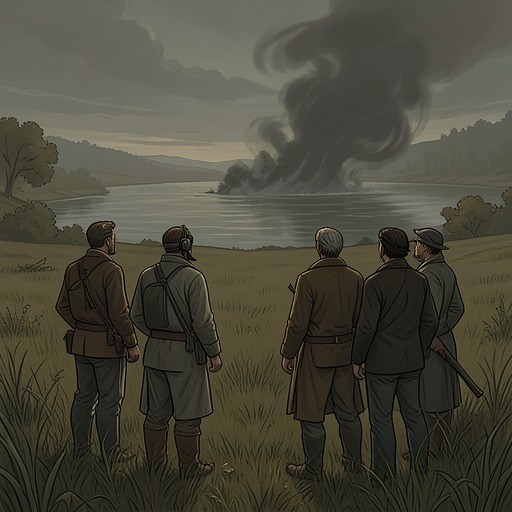
The inquiry begins with the historic flood of November 3, 1927. Afterward, newspaper accounts and reports passed among Wilmarth’s acquaintances described bizarre objects in the swollen rivers. He traced the stories to three principal areas: the Winooski River near Montpelier, the West River in Windham County beyond Newfane, and the Passumpsic River in Caledonia County above Lyndonville. Country residents reported disturbing things in waters pouring down from little-visited hills, and some connected the sightings with traditional stories of hidden beings.
At first, Wilmarth, a literature instructor at Miskatonic University and an amateur student of New England folklore, treated the accounts as rustic superstition. His friends argued that the reports were too consistent and circumstantial to dismiss outright. Their disagreement entered print in letters to the Arkham Advertiser; extracts appeared in the Rutland Herald, while the Brattleboro Reformer reprinted one of Wilmarth’s historical and mythological summaries. By spring 1928, he had become a familiar name in Vermont without yet having visited the state. The distance between reputation and experience would end when Henry Wentworth Akeley challenged his conclusions in private correspondence.
The Hills and Henry Wentworth Akeley’s Evidence
Henry Wentworth Akeley lived in the old family farmhouse south of Townshend Village, on the side of Dark Mountain. He told Wilmarth that he had found footprints nearer his home, heard voices at particular places in the woods, and believed that nonhuman visitors watched people from the hills. His account made the landscape more than a backdrop: remote slopes and forested places were the very reason, in his view, that the beings could operate without attracting ordinary attention.
Akeley’s evidence tied specific sites to particular forms of observation. On May 1, 1915, at about one in the morning, he took a phonograph, dictaphone attachment, and wax blank to a cave near the wooded western slope of Dark Mountain, where it rises from Lee’s Swamp. He chose May-Eve because previous experience suggested the night might bring results. The recording captured fragments of a quasi-ritual gathering: one voice seemed human and cultivated, while another spoke grammatical English in a buzzing voice Akeley considered inhuman. He never heard voices at that spot again.
Photographs and physical traces offered a different, equally incomplete kind of evidence. Akeley sent Wilmarth views of Vermont scenes and objects, including a sharply defined print in an upland mud patch. Its scale could be judged against pebbles and grass; its crab-like form, central pad, and pairs of saw-toothed projections made it difficult to interpret as an ordinary footprint. Later, Akeley reported that a dog had brought a dead creature near the kennel. He said it vanished within hours, and that his attempt to photograph it yielded only an image of the woodshed. The claims echoed the reports of objects seen in the rivers after the flood, but the creature itself left no lasting specimen.
Journey into the Region
When Wilmarth finally traveled to Vermont, the journey emphasized the contrast between his familiar surroundings and the country he was entering. After changing trains in Boston and transferring at Greenfield, he followed the Connecticut River north. He passed the steep slope of Wantastiquet, associated with old legends, and arrived at the Brattleboro station. The conductor’s instruction to set his watch back an hour became a small sign of the distance between modern schedules and the older rural life Wilmarth imagined in the hill country.
That journey led toward Akeley’s isolated home beneath Dark Mountain. Akeley’s own letters had already described his growing fear of the roads: he had driven to Brattleboro to send the record, but said he would go into Townshend for supplies only in daylight. The farmhouse, pressed against a vast wooded slope, placed Wilmarth close to the territory Akeley had warned him about. There he heard an account of interstellar travel accomplished by removing human brains and housing them in cylinders fitted to instruments for sight, hearing, and speech. A mechanical voice then claimed to speak from a brain in a cylinder, while its body rested inside Round Hill, about a mile and a half away. Vermont’s hills thus became, in the account, both a concealed base for activity and a point of contact with journeys far beyond Earth.
Evidence, Disappearance, and Uncertainty
The location’s evidence repeatedly arrives through media that promise confirmation but also expose their own limits. Akeley’s phonograph preserved only fragments of distant voices; photographs made the strange footprint materially legible, yet failed to record the creature he said he had touched. The reported river objects were seen only on the first morning after the flood. The landscape supplies traces, recordings, and witnesses, but not an uncontested, durable proof of what produced them.
That uncertainty governs the account’s ending. Wilmarth fled Akeley’s farmhouse at night through Vermont’s hills, but later stressed that he had seen no actual visual horror in his final experience. Akeley’s disappearance did not settle the question: people found no sign of a guest, the cylinders, or the machines in the house, despite bullet marks inside and out. The house seemed as if its owner had simply gone walking and failed to return. Vermont remains therefore both the scene of the alleged encounter and the setting that frustrates certainty: its remoteness enables the mystery, while the absence of conclusive traces leaves Wilmarth unable to establish whether his inference was right.